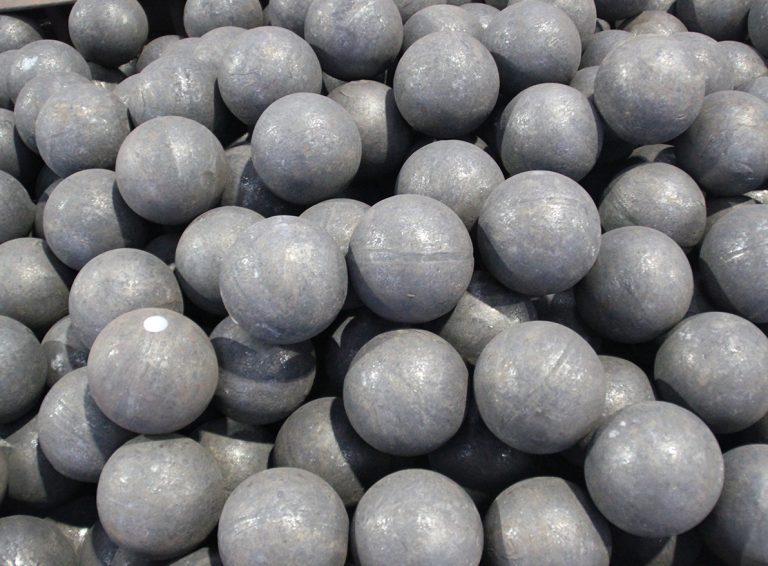
Mill Grinding Balls, Grinding Cylpebs and Grinding Rods


How to Calculate Grinding Media Consumption
Grinding media consumption is the number that turns a media price into a cost per tonne of ore. Plants record it in grams per tonne of ore milled (g/t) or kilograms per tonne (kg/t), and the conversion is direct: 1 kg/t = 1,000 g/t. So 450 g/t is 0.45 kg/t, and at 500 t/h that is 225 kg of make-up balls per hour.
It is the figure that compares unlike media fairly. A 60 HRC forged ball and a 62 HRC high-chrome cast ball carry different prices per tonne and different lives; price per tonne says nothing about which is cheaper to run, while price per tonne of ore does. It also normalises across mill sizes, and it works as a diagnostic: on most plants a step change in g/t shows up before a step change in throughput, and it points at the liner, the feed or the media.
The formula
Over any period where both sides of the balance are measured:
- Consumption in g/t: media added (kg) ÷ ore milled (t) × 1,000
- The same figure in kg/t: media added (kg) ÷ ore milled (t)
- Annual demand: throughput (t/h) × operating hours × consumption (g/t) ÷ 1,000,000 = tonnes per year
The annual form is the definition rearranged: throughput times hours gives tonnes of ore, tonnes times g/t gives grams, and grams divided by 1,000,000 gives tonnes. If you work in kg/t, divide by 1,000 instead.
Four measurement rules keep the result honest:
- Media added means make-up media only. The initial charge is inventory, not consumption. A mill that receives 20 t at commissioning and 3 t a week afterwards consumes 3 t a week.
- Ore milled is dry metric tonnes over the same period. Wet tonnes, or a feed tonnage taken from a different counter than the media issue, will bias the result by several percent.
- Use at least 30 days. A single shift mixes real consumption with the timing of deliveries to the silo.
- Weigh the media. Counting balls and multiplying by nominal unit mass drifts as soon as the size distribution changes.
Typical ranges by ore type
The table gives industry-typical ranges, not a guarantee or a quotation. Two plants grinding the same ore can sit at opposite ends of a range depending on circuit design, target fineness and media quality.
| Duty | Typical consumption |
| Gold and copper SAG milling (ball charge in the SAG mill) | 300–800 g/t |
| Copper ore, primary ball milling | 150–450 g/t |
| Iron ore, ball milling | 250–600 g/t |
| Cement clinker, finish grinding | 20–60 g/t |
| Coal, tube ball mill | 10–35 g/t |
Use the range to sanity-check a measurement, not replace it. If your figure falls far outside it, suspect the tonnage basis before the media.
Worked examples
Example 1: annual consumption from throughput. A copper concentrator runs a ball mill at 500 t/h for 7,000 hours a year and measures 450 g/t.
- Ore milled: 500 t/h × 7,000 h = 3,500,000 t per year.
- Media: 3,500,000 t × 450 g/t = 1,575,000,000 g, or 1,575 t per year.
- Check with the annual formula: 500 × 7,000 × 450 ÷ 1,000,000 = 1,575 t. The two routes agree, as they must.
- Per month: 1,575 ÷ 12 = 131 t. Per operating day, at 7,000 ÷ 365 = 19.2 h: 500 × 19.2 × 0.45 = 4.3 t.
That annual figure is also the fair basis for comparing offers. At a media price of P per tonne, media cost per tonne of ore is 0.00045 × P. A supplier quoting 500 g/t at a lower price per tonne may still be the more expensive choice; the multiplication decides it, not the price list.
Example 2: make-up from a known charge. A smaller ball mill carries a 60 t charge, mills 1,000 t per day and holds 210 g/t.
- Make-up per day: 1,000 t × 210 g/t = 210,000 g = 210 kg.
- Top-up every three days: 210 × 3 = 630 kg per addition.
- Full charge turnover: 60,000 kg ÷ 210 kg per day = 286 days, about 9.5 months. In practice worn balls are also removed and the charge re-graded, so turnover is not replacement.
- Annual: 210 kg × 350 operating days = 73,500 kg = 73.5 t. Cross-check: 1,000 ÷ 24 = 41.7 t/h, and 41.7 × 8,400 × 210 ÷ 1,000,000 = 73.5 t.
If the two routes disagree by more than a few percent, the ore tonnage is usually the problem: wet versus dry tonnes, or a belt scale that has not been calibrated.
What changes your number
Six variables move g/t more than anything else on a working plant.
- Ore hardness and target fineness. A higher Bond work index, or a finer P80, raises specific energy and media consumption together. A 10% harder ore can move g/t by 10–20%.
- Ball size. Larger balls break coarse feed but waste energy above the size the duty needs; smaller balls give more surface area and more surface per tonne of metal, so specific wear tends to rise.
- Mill speed. Above roughly 75% of critical, impact energy climbs quickly, and wear and breakage follow.
- Liner condition. Worn lifters flatten the charge trajectory, the charge slips, and wear rises. A fresh liner set often shows a short-term change in g/t while the profile beds in.
- Pulp density. A dilute pulp lets balls strike liners directly; an over-dense pulp cushions the charge, cuts grinding efficiency and raises the circulating load. Most ball mills run between about 65% and 80% solids by weight, depending on the duty.
- Media quality. Hardness, microstructure, bar straightness and casting soundness set how many grams a tonne of ore the ball gives up before it is too small to do work.
Measurement error belongs on that list too. A consumption figure that moves by 15% in one month, with no change in ore or circuit, is more often a weighing or tonnage problem than a metallurgical one.
When to change the material
A consumption above about 550 g/t in a ball-milling duty is worth investigating. First rule out the circuit: liner wear, a coarser feed, a speed change, a denser pulp, a classifier passing too much. If those are stable and the number stays high, the media is the variable.
Two signals point at a grade change. If breakage is high and balls discharge cracked or flattened, the mill needs toughness: a higher-alloy forged grade such as B3 or 70Cr2, not a harder cast ball. If breakage is low but balls wear out of round, or the slurry is abrasive and slightly acidic, high-chrome cast is usually the better trade, with 18–26% Cr and 58–65 HRC doing the work through carbides rather than bulk hardness. Rare-earth micro-alloyed forged grades sit between the two where impact and abrasion are both present.
Compare on cost per tonne of ore — consumption multiplied by price per tonne — and not on price per tonne of media. A ball that costs 20% more and lasts 40% longer is cheaper; one that costs 20% less and breaks is not.
Send us your mill data — throughput, operating hours, measured g/t, feed and product size, current media specification and breakage observations — and we will check the calculation and tell you whether the media or the circuit is responsible. Use the contact form and put “media consumption” in the subject line.