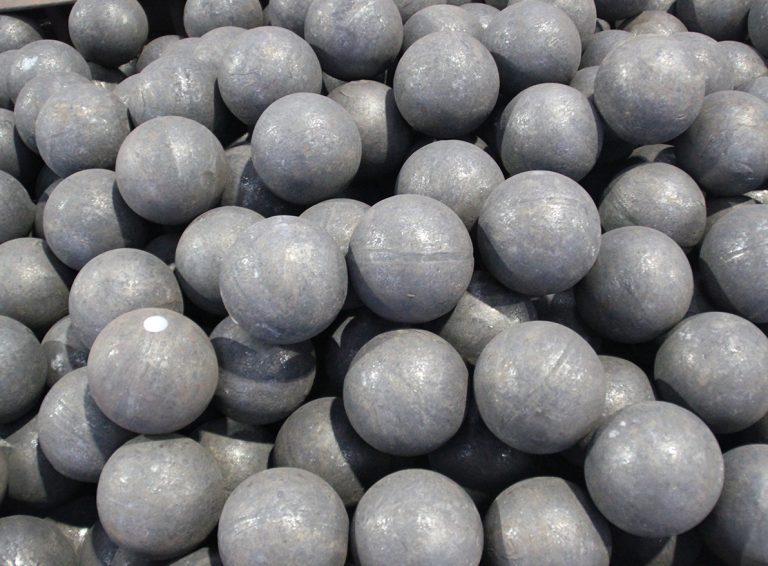
Mill Grinding Balls, Grinding Cylpebs and Grinding Rods

Forged vs Cast Grinding Balls: Which to Choose
The choice between forged and cast grinding balls comes down to what breaks the ball in your mill. If the answer is impact — a SAG mill, a large-diameter primary ball mill, a coarse first chamber with a top size above 60 mm — use forged. If the answer is abrasion at low impact — a cement second chamber, a coal tube mill, a fine regrind — use cast, or cast cylpebs. That distinction explains most media selection decisions in a concentrator or a cement plant, and it should be settled before anyone compares price per tonne.
The two products fail in different ways. A forged ball is worked from rolled bar, so it is dense, free of casting porosity, and tough enough — 12–18 J/cm² on our standard grades — to deform under a mis-hit instead of splitting. A cast ball gets its wear resistance from carbides in the microstructure, which is why high-chrome cast iron reaches 58–65 HRC. Hardness and toughness move in opposite directions, though, and a ball that cracks at 100 mm costs more than the metal it contains: it leaves the charge, it can damage liners and trommel screens, and it disturbs the size distribution the circuit was designed around.
Most circuits do not pick one type for everything. They pick per mill, and often per chamber.
How each type is made
Forged balls begin as round steel bar, cut to billet length, heated to austenitising temperature, then shaped by forging or skew rolling. The deformation closes internal defects and turns the cast grain structure into a flow line that follows the ball’s contour. After quenching and tempering, the result is a through-hardened ball with a fine pearlitic or tempered martensitic structure: typically 55–65 HRC, 12–18 J/cm² impact value, and a breakage rate below 1% in normal service. Our forged range runs from 20 mm to 150 mm in 45#, 60Mn, 65Mn, 70Cr2, B2 and B3. The carbon-manganese grades cover general ball-mill duty; the alloy grades are for the larger diameters and the harder ores, where a cheaper chemistry wears out of round before it wears out.
Cast balls are melted and poured into metal or sand moulds, then heat treated. There is no deformation step, so the properties come from chemistry and solidification rather than from working the metal. Chrome content sets the grade:
- High chrome: 18–26% Cr, 58–65 HRC. Hard carbides in a martensitic matrix, and the best abrasion resistance in the cast family.
- Medium chrome: 8–12% Cr, 45–55 HRC. A middle grade for cement and mining duty where wear is moderate.
- Low chrome: 1–3% Cr, 40–50 HRC. The lowest-cost cast ball, suited to low-impact and low-abrasion duty, not to large mills.
Casting also produces shapes that cannot be forged economically, which is why cylpebs exist: 20×30 mm up to 60×70 mm, with more surface per unit of mass than a ball and a better fit for fine grinding in a second chamber.
Performance comparison
| Property | Forged | Cast |
| Manufacturing process | Bar cut to length, heated, forged or rolled to shape, quenched and tempered. Grain flow follows the contour. | Melted and poured into moulds, then heat treated. Properties come from chemistry and solidification. |
| Hardness (HRC) | 55–65, essentially through the section | Low chrome 40–50; medium chrome 45–55; high chrome 58–65 |
| Impact toughness | 12–18 J/cm²; deforms before it cracks | Lower, and falls as carbon and chrome rise. High chrome is hard but notch-sensitive. |
| Breakage rate | Below 1% in normal service | Higher and more variable; low chrome is the most prone, high chrome the least |
| Typical cost | Higher price per tonne; in high-impact duty, fewer tonnes bought per year | Lowest price per tonne at low and medium chrome; high chrome close to forged |
| Best-fit duty | SAG mills, large primary ball mills, coarse first chambers, hard and abrasive ore | Cement second chambers, coal mills, fine grinding, low-impact abrasive duty |
| Typical sizes | 20–150 mm | Cast balls sized to the chamber; cylpebs 20×30 mm to 60×70 mm |
Read the table as a trade-off between two failure modes. A forged ball in a large mill fails by gradual wear; a cast ball in the same mill may fail by fracture. Wear costs metal. Fracture costs metal plus downtime plus the risk of liner damage, and in a SAG mill or a 5 m primary ball mill that asymmetry settles the question before price does.
Hardness on its own does not determine wear rate. A 62 HRC high-chrome ball and a 60 HRC forged ball will not wear at the same rate in the same slurry, because the mechanism differs: carbide pull-out and chipping in the cast ball, micro-cutting and fatigue in the forged one. Compare them on grams per tonne in your own mill, not on the data sheet.
How to choose for your mill
Four inputs decide most of it: mill type and diameter, feed top size, ore hardness and abrasion index, and what the current media is doing — consumption in g/t, breakage rate, and the shape of the balls at discharge.
Rule of thumb
- SAG mills and SAG discharge duties: forged, 100–150 mm, B2 or B3.
- Primary ball mills above about 4 m diameter, or any mill with F80 above 10–15 mm: forged, 60–100 mm.
- Cement first chamber: forged, 60–90 mm.
- Cement second chamber, coal mills, limestone and other low-impact fine grinding: cast cylpebs or cast balls, medium or high chrome depending on abrasion.
- Regrind and fine grinding (P80 below 75 µm): 20–40 mm forged balls or cylpebs; high chrome where abrasion, not impact, is the limit.
- If breakage is above 1–2%, or balls discharge out of round: change the grade before you change the tonnage.
Mixed charges: forged first chamber, cast second
Two-chamber cement mills and many coarse ball mills run a mixed charge, and that is usually correct. The first chamber does the breaking: forged balls, 60–90 mm, chosen for toughness. The second chamber does the grinding: cast cylpebs or 15–40 mm cast balls, chosen for surface area and abrasion resistance. The split is not only a cost decision; it puts tough media where impact happens and hard media where sliding and abrasion happen. Keep the grades separate in the silo, the kibble and the addition log. If a mixed charge is recorded as one number, the g/t figure stops meaning anything.
What to send us
Mill type, diameter and % critical speed; feed F80 and product P80; Bond work index and abrasion index if you have them; current media size, grade and measured g/t; and any breakage you are seeing. With those we can propose a size distribution and a grade for each chamber.
If you want a recommendation rather than a catalogue, send the data through our contact form. Full specification ranges are on the forged grinding ball and cast grinding balls pages.