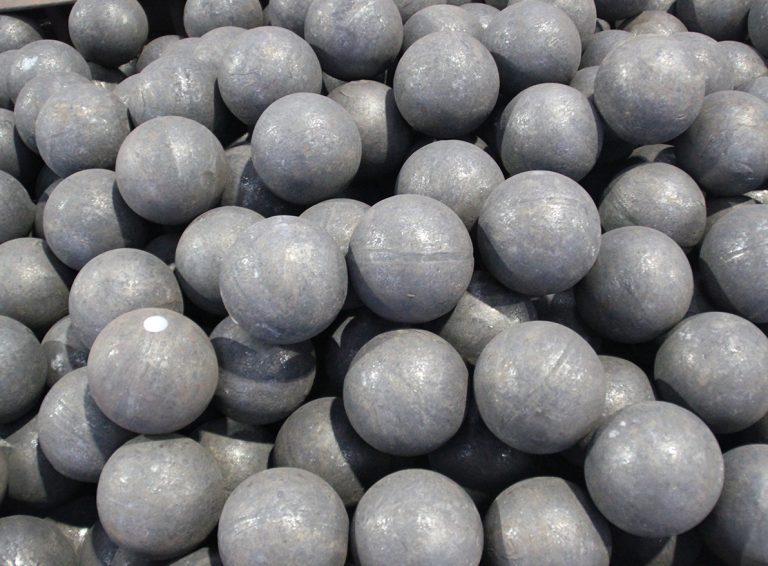
Mill Grinding Balls, Grinding Cylpebs and Grinding Rods


SAG Mill Ball Size Selection: 90–150 mm Guide
Ball size in a SAG mill follows from four inputs: the F80 of the feed, the ore’s resistance to impact and abrasion, the mill’s inside diameter, and the mill speed. For make-up balls, a practical starting range is 90–150 mm (3.5–6.0 in). Initial charges are usually larger, commonly 125–150 mm, because the first weeks of operation must break a coarse feed without the benefit of a stable charge. Treat these numbers as a starting point. The final size should be confirmed against power draw, throughput and product size from the mill itself.
A Bond-style approach makes the same point in a more structured way. Bond’s empirical ball-size relationship links the required ball diameter to feed F80 and ore work index, then applies corrections for mill diameter, speed and circuit type. In SAG service the relationship is a scaling guide, not a precise prediction: impact breakage dominates, the charge is a mixture of sizes, and the feed changes over the life of the pit. Use it to set the first charge and to compare ores, then tune with operating data.
The rule of thumb is simple: ball diameter rises with feed F80 and ore competence. Mill diameter and speed modify the result: a larger mill delivers more energy per ball, so the same duty can sometimes be met with a slightly smaller top size, while a higher tonnage still needs enough large balls to break the coarse feed. In its simplest form, ball diameter ≈ f(feed F80).
What drives ball size
Feed F80 is the first lever. A finer, pre-crushed feed needs less impact energy per collision, while a coarse, competent feed needs larger balls to avoid skating over the surface. Ore competence matters as much as size: a hard, massive ore with low Axb or high work index needs more impact energy than a softer, fractured ore at the same F80. Abrasion resistance then controls ball consumption and the cost per tonne, not the top size alone.
Mill diameter and speed set the energy per ball. At the same ball size, a larger mill lifts balls higher and delivers more impact energy; a higher speed does the same until the charge starts to centrifuge. Charge level and ball filling also change the number of collisions. A mill running at 12–15% ball filling by volume has more contact points than one at 8%, but also more mass and higher power draw. Keep these variables in the decision, because a ball size that works in a 20 ft mill may be too large in a 32 ft mill.
Sizing table and worked example
The table below is a simplified empirical guide for SAG make-up balls. It assumes a competent ore, a mill at 70–75% critical speed, and a feed with no extreme top size. Interpolate between rows rather than treating the numbers as fixed.
| Feed F80 (mm) | Recommended make-up ball diameter (mm) | Typical application |
|---|---|---|
| 100 | 80 | Fine, pre-crushed feed; soft to medium ore |
| 150 | 100 | Medium feed; mixed ore |
| 200 | 125 | Coarse feed; competent ore |
| 250 | 150 | Very coarse feed; hard, massive ore |
Table notes: diameters are nominal make-up sizes; the initial charge may be one step larger. This is an empirical starting point, not a design guarantee. Verify it against mill power, specific energy and product P80.
Take a SAG mill with a 9.75 m inside diameter, 72% critical speed, feed F80 of 180 mm, and ore with a Bond work index of 16 kWh/t. Interpolating the table gives 110–120 mm. For a competent ore and coarse top size, select 125 mm and keep 20–30% of the make-up at 80–100 mm to fill voids and provide attrition. If the mill cannot hold target power at design throughput, increase the 150 mm proportion before raising total ball charge. If power is above target and product is already fine enough, reduce the top size or addition rate.
Oversized balls show up as rising liner and grate wear, a higher ball breakage rate, and a coarser product with less attrition. Impact energy per collision is high, but the number of contacts is lower, so overgrinding falls and the circuit may carry a heavier circulating load. Undersized balls show the opposite pattern: throughput falls, the charge can stall, the mill can choke on its own load, and pebble discharge or a coarse transfer size becomes visible. Confirm either diagnosis with a charge survey and power history before changing the size.
Making up the charge
Most SAG mills use one make-up size for simplicity. A single 125 mm ball is easy to inventory and to add through the ball chute, and it keeps the charge consistent. A mixed charge is better when the feed contains a wide range of sizes or when the mill needs both impact and attrition. A common split is 70–80% of the make-up at the selected top size and 20–30% at one size below it. Do not mix sizes at random: define the ratio, record it, and keep it stable between surveys.
Make-up by power is the most direct method. Set a target power draw for the design throughput and add balls when power falls below the lower control band. Add in small increments, allow the mill to stabilise, and record the response. This method responds to ore changes, but it can hide a falling charge if the mill is run at a fixed tonnage. Pair it with a weekly charge-level measurement.
Make-up by tonnage uses ball consumption. If the circuit consumes 0.55 kg of balls per tonne of feed and runs at 800 t/h, the steady-state addition is 440 kg/h. Convert that to a number of balls: a 125 mm forged ball weighs about 8.0 kg, so the rate is roughly 55 balls per hour. The calculation is only as good as the consumption figure, so reconcile it monthly against ball inventory and power draw.
Ball material for SAG service
For SAG duty, specify forged balls in 60Mn, 65Mn, B2 or B3 steel, hardened and tempered to HRC 58–62. Impact toughness should be at least 15 J/cm² and the breakage rate in a defined drop test below 0.5%. These values are a purchase specification, not a marketing claim: ask for the heat number, the hardness distribution across the diameter, and impact test results for the lot. High-chromium cast balls are common in ball mills, but their lower toughness makes them less suitable for the high-impact SAG charge. A 125 mm ball that spalls or breaks becomes a piece of tramp metal and a safety risk, so toughness matters as much as hardness.
To select make-up balls for a specific SAG duty, review the forged SAG mill grinding balls range, or send the feed F80, ore work index, mill diameter, speed and target throughput to the contact page. The specification can then be matched to the duty rather than chosen from a generic table.