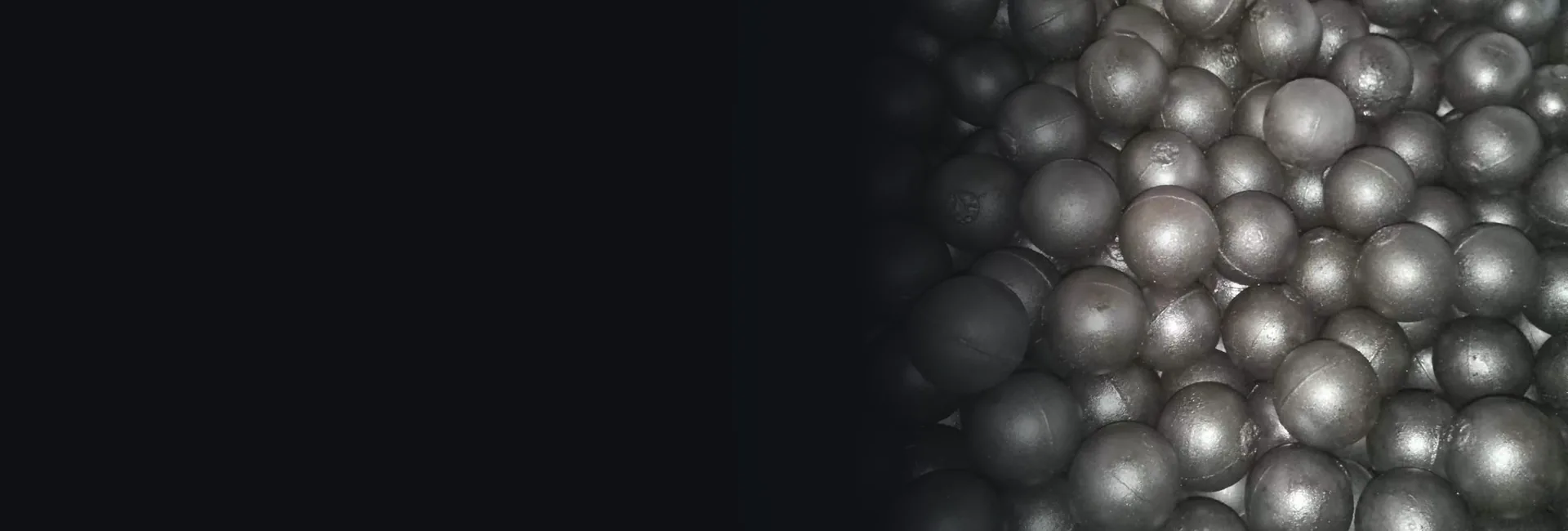
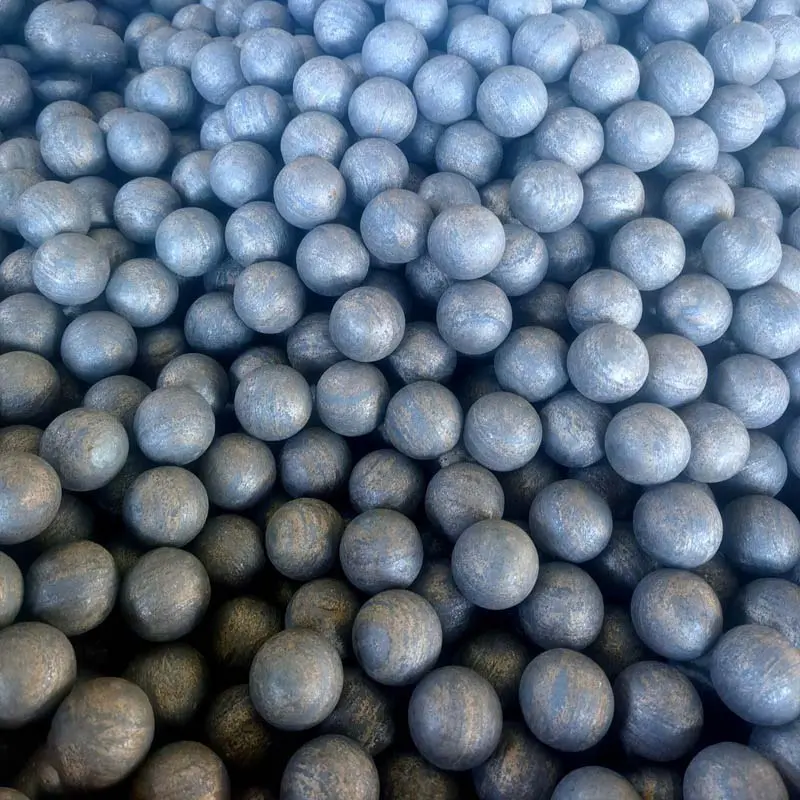
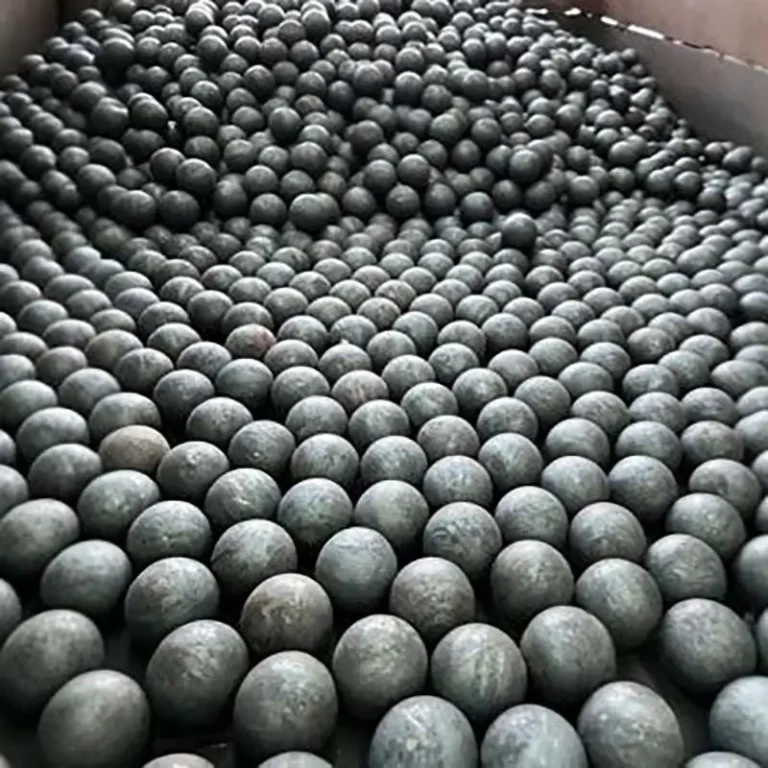
Rare earth alloy grinding balls are forged from steel that is micro-alloyed with cerium and lanthanum before rolling. The rare earth elements refine the grain size, remove sulphur and oxygen from the melt and make the carbide distribution more uniform, which lifts hardness to HRC 60-65 without the drop in toughness that usually comes with a harder ball.
These balls are made for mills where standard B2/B3 media wears out too quickly – typically hard, abrasive ores such as quartz-rich gold ore, copper porphyry and iron ore. They are supplied from 40 mm to 120 mm and can be mixed with standard forged balls in the same charge.
Property comparison
Material
Hardness (HRC)
Impact (J/cm2)
Relative wear resistance*
45#
55-58
>=12
1.0
60Mn
58-60
>=12
1.2
B2
58-62
>=15
1.5
B3
60-62
>=15
1.7
Rare earth alloy
60-65
>=18
1.8-2.2
* Laboratory pin-on-disc comparison against 45# reference, same ore slurry. Actual wear life depends on ore hardness, mill speed, ball size and pulp density – we run a free wear-rate review before recommending a grade.
Chemical composition (typical)
Grade
C (%)
Si (%)
Mn (%)
Cr (%)
RE addition (%)
RE-60
0.60-0.70
0.20-0.40
0.80-1.00
0.40-0.60
0.03-0.08
RE-65
0.65-0.75
0.20-0.40
0.90-1.10
0.60-0.90
0.05-0.10
What rare earth modification changes
Grain size refined by 1-2 ASTM grades, which raises both hardness and toughness
Sulphur and oxygen reduced to below 0.02%, cutting inclusion-initiated spalling
More uniform carbide network, so the ball wears evenly instead of pitting
Higher tempering resistance – the ball keeps hardness in the hot zone of the mill
Ordering notes
Sizes: 40, 50, 60, 70, 80, 90, 100, 110 and 120 mm
MOQ 20 t per size; 5 t trial lots available for a first order
Packing: 1 t bulk bag, 850 kg steel drum, or 2 t pallet
Lead time: 25-35 days, depending on size mix
Tell us your current ball consumption (kg per tonne of ore) and the mill discharge size – we will calculate whether a rare earth grade pays back at your ore hardness. Ask for a wear-rate comparison.
Forged balls made from steel micro-alloyed with cerium and lanthanum. The rare earth addition refines the grain and removes sulphur and oxygen, lifting hardness to HRC 60-65 without losing toughness.
How much longer do they last?
In laboratory pin-on-disc comparison against a 45# reference they show 1.8-2.2x the wear resistance of B2/B3. Real mill life depends on ore hardness, mill speed and pulp density, so we review your g/t before recommending a grade.
Which applications benefit most?
Hard, abrasive ores - quartz-rich gold ore, copper porphyry, iron ore - and any circuit where consumption is above roughly 550 g/t with standard media.
What is the MOQ and lead time?
MOQ is 20 t per size, with a 5 t trial lot for a first order. Lead time is 25-35 days depending on the size mix.
Are they compatible with standard balls?
Yes. They can be mixed into an existing charge; many customers use them as the make-up ball while the base charge stays B2/B3.